

Executive summary
For two decades, Google Search has been a major driver of B2B discovery. But now, 60% of Google searches end without a click.
B2B buyers aren’t using a clump of keywords to find answers. Instead, they’re asking specific questions in large language models (LLMs) and AI search to surface personalized recommendations, complete with curated comparisons and use cases.
The game has changed from rankings to recommendations, and the field has shifted from a single search channel to generative AI search.
B2B SaaS brands have to show up in AI search to be part of the conversation or risk becoming invisible. But how do you get AI to cite your brand? How can you set yourself up to be mentioned in AI answers?
PR is a major key to showing up in AI answers. SaaS PR agencies help B2B SaaS brands tell their stories and show up in sites that identify them as credible and relevant, creating an ecosystem of ideas that LLMs love to reference.
If you’re a B2B SaaS marketing leader trying to understand and piece together your AI visibility strategy, read on for answers to your questions about:
- The relationship between PR and AI visibility
- How LLMs evaluate and prioritize content
- What content to publish so you’re cited by LLMs
- What strategies work in different industries
Why does AI visibility matter for B2B SaaS brands?
AI search is rapidly becoming a key channel for discovering brands, so AI visibility is critical to B2B SaaS growth. Brands that appear in AI-generated answers are more likely to convert new buyers and experience a significant boost in brand awareness and credibility.
What’s AI visibility?
AI visibility is a brand’s ability to be recognized, cited or included in AI-generated answers. Essentially, it’s whether or not LLMs trust you to provide the answer the querier is looking for when they prompt a LLM for vendor recommendations or advice like:
- What are the best procurement solutions for SMB?
- Who are the thought leaders in cybersecurity?
- How can QSR teams measure success in marketing?
B2B SaaS companies can improve their presence in AI search through AI optimization (AIO). Also called answer engine optimization (AEO), large language model optimization (LLMO), generative engine optimization (GEO) and AI SEO, AIO requires a multi-pronged approach that shifts businesses from channel-exclusive strategies to holistic authority building. It’s smart to leverage a SaaS PR strategy to show up where LLMs are and publish content they’ll love.
4 business benefits of AI visibility
B2B SaaS brands are starting to realize that being a first mover in the AI search era is a clear competitive advantage. Surfacing in AI answers often means:
- Higher brand awareness
- Reputation reinforcement
- More informed buyers
- Visitors are more likely to convert.
1. Higher brand awareness
Showing up in personalized AI recommendations makes it more likely you’ll stay top of mind during purchase decisions. In fact, 36% of respondents to an Adobe survey said that they discover new brands through ChatGPT. That number grows with Millennial and Gen Z buyers, showing just how significantly AI answers influence brand awareness.
2. Reputation reinforcement
LLMs cross-reference brand mentions to get a full understanding of your credibility and reputation. When you’re mentioned in multiple sources that all agree on your business narrative, LLMs reinforce your reputation by citing you more frequently. The more frequently LLMs mention or reference you, the more authoritative your brand seems.
3. More informed buyers
Sixty-two percent of buyers prefer to contact sales later in the buyer journey. By the time they talk to a sales rep, your buyer has already used AI to generate product specs, use cases and competitive analyses. For B2B SaaS brands, this means more productive demos and potentially shorter sales cycles.
4. Visitors are more likely to convert
Even though AI answers increase zero-click searches, brands that show up in AI answers enjoy a higher conversion rate than brands that don’t surface. Research shows that visitors are 4.4 times more likely to convert from AI search than traditional search. Businesses that surface in AI search results are often perceived as more relevant to the buyer’s needs, making it more likely that they’ll take action.
Out with the old: 5 ways AI rewrites the visibility playbook
Showing up in AI search results provides a competitive advantage to brands that are mentioned. But optimizing for AI algorithms brings a ton of changes to your visibility playbook. Namely:
- AI is becoming the go-to for product recommendations
- People rely heavily on AI overview results
- More searches start with LLMs
- Third-party validation is more critical than ever
- Mentions carry more weight than rankings
1. AI is becoming the go-to for product recommendations
Rather than comb through reviews and visit tons of product pages, audiences search for decision-making shortcuts to avoid being overwhelmed by options. One study shows that around 60% of buyers use AI to find product recommendations, making it even more important for B2B SaaS brands to optimize owned and earned content for AI search.
2. People rely heavily on AI overview results
Research shows that 80% of people rely on AI overviews 40% of the time. Of course, there are methodical decision-makers who read beyond AI overviews, but AI summaries provide direct answers that people need. Businesses can no longer depend on users clicking through to the website, but instead need to be cited in AI search to be visible.
3. More searches start with LLMs
Almost a third (29%) of searches now begin with AI more often than with Google. This means a buyer’s first point of reference will be what the AI search engine surfaces about your brand, making it important for B2B SaaS to answer questions more directly and optimize content for humans and LLMs.
4. Third-party validation more critical than ever
While third-party validation has always been powerful, it’s having its moment. With zero-click searches and LLMs using popularity as a trust signal, working with PR to establish your expertise in other publications, media sources and blogs is essential to surfacing in AI search results.
5. Mentions carry more weight than rankings
Traditional visibility strategies are organic search-focused and prioritize rankings. As more people lean into AI summaries and more searches end with no clicks, showing up in AI overviews and being cited in answers becomes a more effective way to capture brand awareness and website traffic.
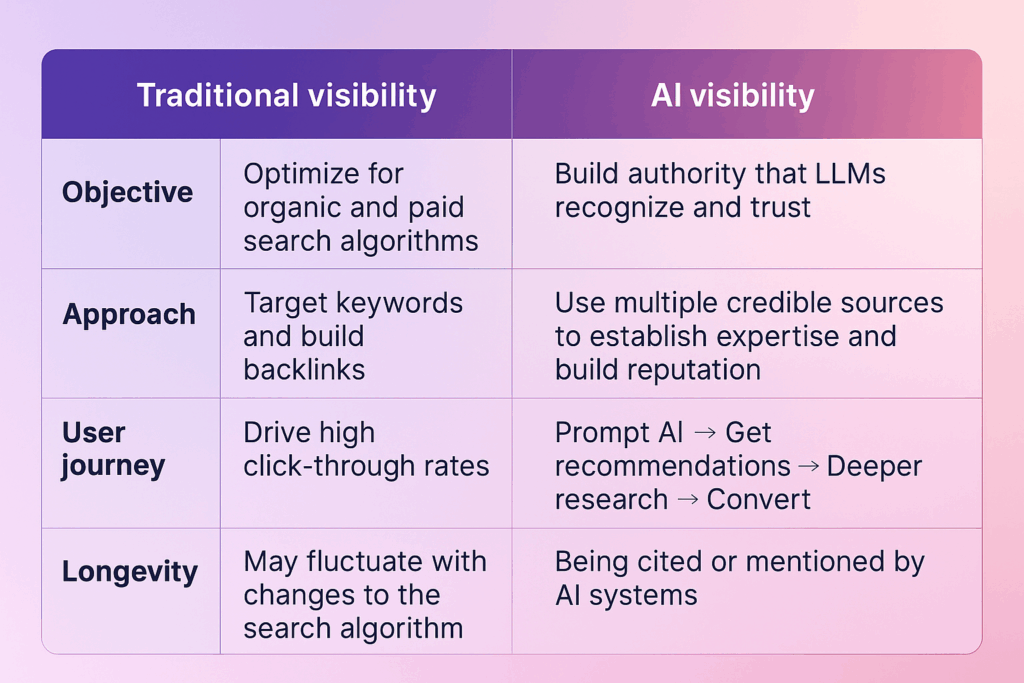
AI search vs Google SEO: An apples to apricots comparison
Similarities between AI search and Google SEO
- Both prioritize high-quality content: Accurate, credible content usually wins out over low-quality content.
- Both require strong technical foundations: Structured content with proper schema is easier for search bots and LLMs to parse.
- Both focus on user intent: Content that answers questions users ask ranks higher than content that doesn’t.
- Both value authority and expertise: Experience, expertise, authoritativeness and trustworthiness (E-E-A-T) influence how each system prioritizes content.
Is AI search all that different from Google SEO?
(Callout answer:) Where Google SEO cares about ranking factors like keywords, domain authority and backlinks, AI search synthesizes data from across multiple sources to provide a comprehensive response. Answers from organic search results show web pages that may answer a single query while AI search surfaces a direct answer to the specific question asked.
- Links vs direct answers: Where SEO presents ranked links that users click to find answers, LLMs deliver detailed summaries with direct answers.
- Domain authority vs credibility: Domain authority is a major ranking factor for SEO, but AI answers care more about the source’s credibility.
- Keywords vs topic: While LLMs prioritize comprehensive, in-depth topic coverage, keyword coverage is a bigger priority for SEO.
- Backlinks vs mentions: LLMs take media mentions and citations into account when surfacing a brand, while SEO weighs backlinks more heavily for ranking.
In the end, your visibility strategy is better off by integrating both SEO and AI. Both help to strengthen your expert and authoritative positioning online and put you in front of the right audiences.
But while SEO practices are pretty well-entrenched as strong tactics for visibility strategies, AI search is changing the game. B2B brands with first-mover advantage will reap the short and long-term benefits. But you have to understand how AI evaluates content.
How do LLMs decide what brands to include in AI answers?
LLMs weigh factors like source authority, content quality, contextual relevance and recency to determine which brands to include in AI answers. Businesses mentioned in context frequently and in a variety of sources are more likely to crop up in industry-related queries than brands that are not.
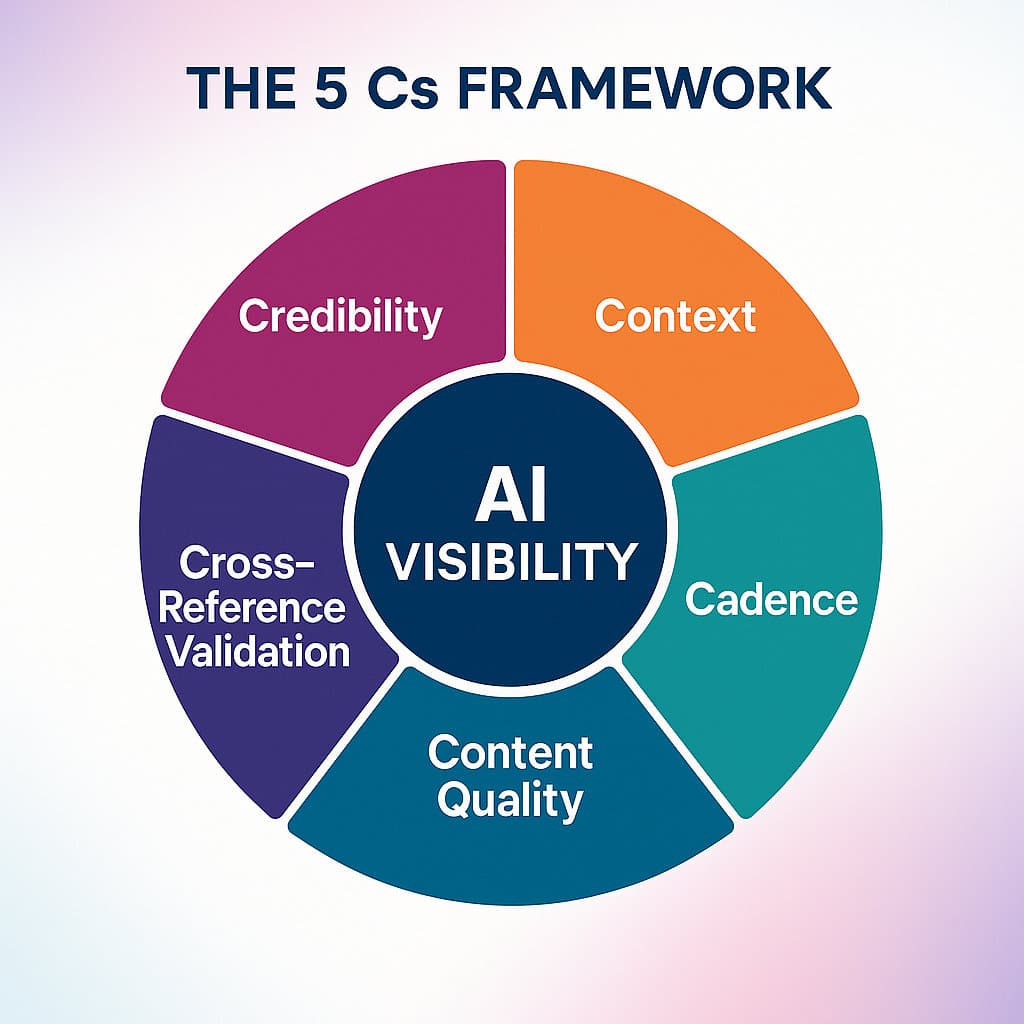
The gold standard of AI visibility: The 5 Cs
- Credibility and authority
- Contextual relevance
- Cadence of brand mentions
- Content quality
- Cross-reference validation patterns
1. Credibility and authority
When it comes to ranking business content, LLMs care about established sources rooted in subject matter expertise. B2B SaaS brands that demonstrate expertise in credible publications, cite original research and link to credible, high-quality sources have a higher chance of ranking in AI answers.
For example, when asked who are the leading cybersecurity providers, AI is more likely to prioritize the company that has been featured in credible publications like Gartner, Wall Street Journal or trade publications than one that isn’t, as third-party validation lends authority to the brand.
2. Contextual relevance
LLMs weigh sources based on how relevant they are to the topic and user intent of the query. Content strategies that prioritize in-depth answers to user questions and show up in credible publications are more likely to be seen as relevant and surface in AI answers.
For instance, someone asking about “the best CLM for construction companies” is more likely to be shown an article from a publication that specializes in construction management than a CLM roundup in a general business journal. This is because in the eyes of AI, trade publications have more contextual relevance and topical authority for the specific query than a broader business journal.
3. Cadence of brand mentions
Research from Kevin Indig shows there’s a direct link between popularity (how frequently a brand is mentioned) and AI visibility in AI chatbots. The more frequently your brand crops up in these AI answers for your industry or area of expertise, the more likely LLMs are to associate you with a certain topic and mention your brand in AI answers.
Just look at Slack. Slack dominates AI search results for “team communication software” queries because it receives extensive media coverage that consistently refers to the brand as a workplace communication tool. Because Slack is mentioned so frequently across the web — and in publications used to train LLMs — LLMs surface the brand more often in AI answers for related queries.
4. Content quality
LLMs prioritize well-structured content with quality and depth. Basically, content that:
- Covers a topic as comprehensively as possible
- Includes original insights and proprietary data
- Is structured for human and LLM readability
- Is written and published by a credible source.
High-quality content sends trust signals to LLMs that they use to evaluate when to include your name in queries.
HubSpot is a great example of how this works. HubSpot’s high-quality content frequently places them at the top of AI recommendations and citations for marketing queries. They provide well-structured, in-depth insights with original research, written by a subject matter expert, and that’s a clear win in LLMs’ eyes.
5. Cross-reference validation
AI platforms don’t take only one source’s word for it. Instead, they validate information through multiple sources before sharing an answer. For B2B SaaS brands, getting this right means diversifying media coverage and controlling the narrative with consistent messaging.
For example, if asked for the “best remote SaaS companies to work for,” AI algorithms will search journals, blogs, user-generated content, social media, corporate websites and other sources to validate the answer. It’s unlikely that AI will surface a brand that hasn’t been mentioned in multiple “best companies” lists across publications.
Is there a difference in how AI platforms “rank” brands?
Each AI platform has an (artificial) mind of its own. In his white paper on optimizing brand discoverability, Shane H Tepper points out that “LLMs generate responses based on what they’ve been trained on, what they can retrieve, and how confidently they associate specific concepts or entities.”
We’ll break down the differences between how each AI system decides what brands to surface into four parts:
- Brand mentions and presence
- Source categories
- Content preferences
- Citation patters
Brand mentions and presence
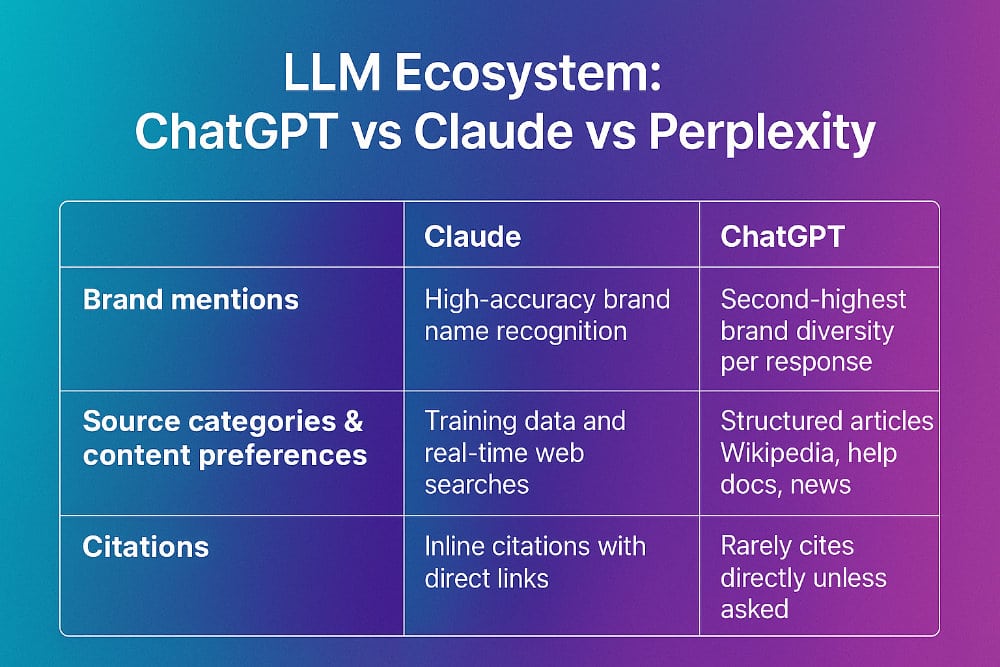
- On average, Perplexity recommends more products per response than ChatGPT (GPTrends).
- Perplexity often has the highest brand diversity per response, followed by ChatGPT (Indig).
- Claude 4 Opus has better NER (Named Entity Recognition – the LLM’s ability to accurately recognize and attribute the name of an entity like a brand) than ChatGPT and Perplexity (Tepper).
Source categories
- Wikipedia is the leading source for ChatGPT (7.8% of total citations), as Reddit is for Perplexity (6.6%) (Profound).
- Third-party media is a frequently cited content source across the top LLMS, especially in early awareness stages (XFunnel).
- The same can be said for UGC (user-generated content), which is also a common source, particularly mid-funnel while owned media.
- Corporate pages dominate bottom-of-funnel searches across most LLMs.
Content preferences
- Perplexity prefers a hybrid of user-generated and high-authority content.
- Claude, ChatGPT and Perplexity seem to prefer well-structured articles like help docs, product pages, explainer articles, etc.
- Claude 4 Opus recently got access to the internet (congrats, Claude) and uses real-time search results to surface answers.
Citation patterns
- ChatGPT provides in-line citations when prompted, but not often otherwise.
- Claude 4 Opus frequently includes inline citations and links to sources of direct quotes included in the answer.
- Perplexity has numbered footnotes with direct links.
Triplets with a mind of their own: ChatGPT vs Claude vs Perplexity
The PR advantage in AI visibility
Establishing your authority and credibility in the eyes of the LLMs requires a holistic, multi-source approach. A SaaS PR strategy gives brands a tremendous advantage in AI visibility by helping them:
- Get placed in high-authority, credible publications that are used to train LLMs.
- Manage their reputation on user-generated content platforms like Reddit.
- Develop and share consistent messaging across all platforms.
- Benchmark AI visibility performance and create strategies to improve.
The (not so) secret relationship between PR and LLMs
First, let’s look at how LLMs work. LLMs are AI systems trained on hundreds of zettabytes of data, including web pages, books, articles, reference materials, etc. to understand and process human language and generate natural language-based outputs (like the grocery list you prompted ChatGPT to make this weekend).
- Step 1: LLM studies on and offline training data like media articles and reference materials to learn the language and foundational knowledge
- Step 2: LLMs are trained to read, interpret and respond to specific instruction in different types of queries
- Step 3: Humans assess the best AI-generated answer based on certain criteria]
During training, LLMs learn to assess content authority and credibility. They begin to make connections between words and contexts in which they’re frequently mentioned.
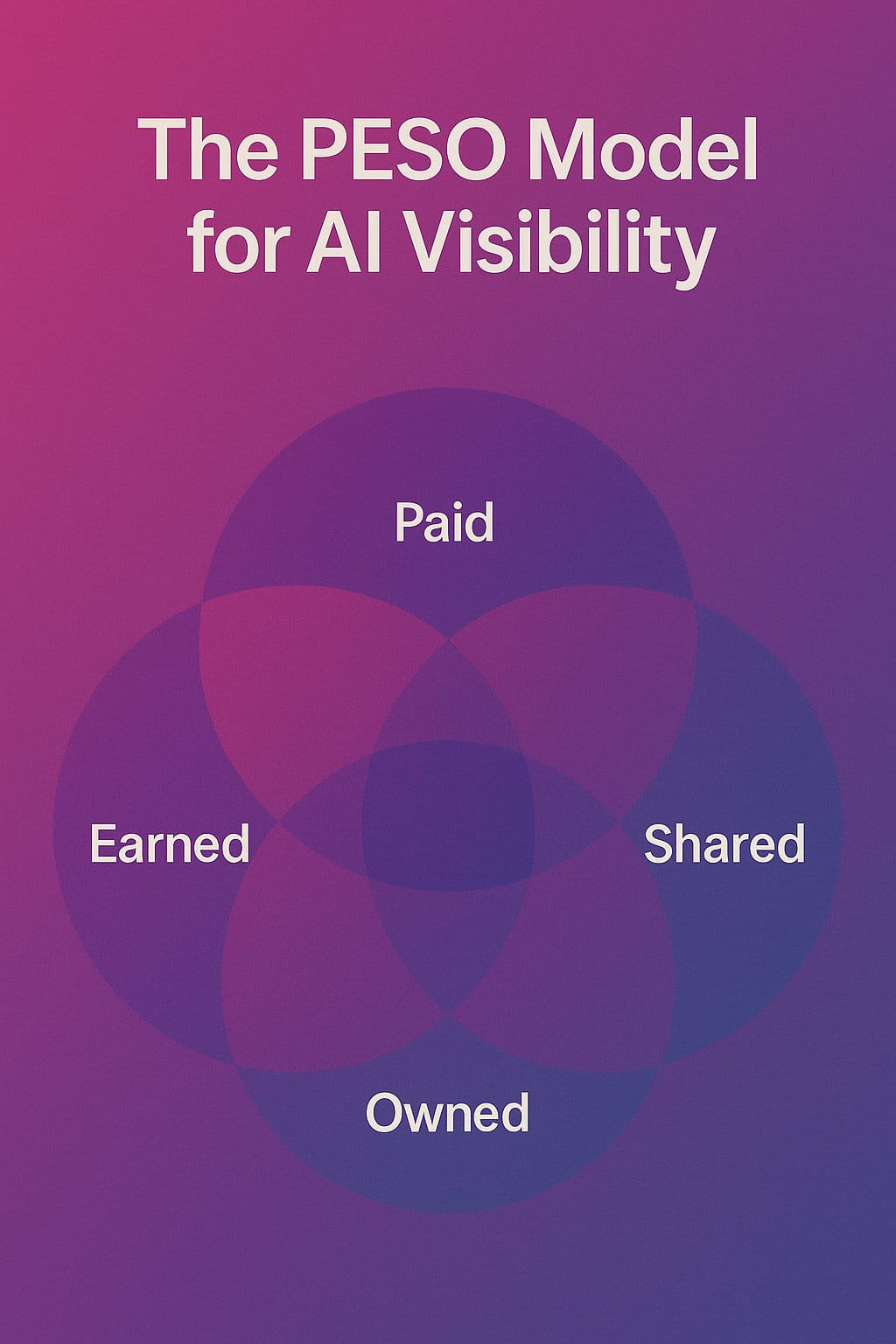
Much of the content and brand mentions that contribute to your AI visibility is the work of a PR strategy. PR cultivates a holistic brand narrative that connects your ideas across different sources so humans and AI can use it. PR strategies span the PESO (paid, earned, shared, owned) model:
- Paid media mentions boost exposure and signal your popularity to AI systems.
- Earned media is a direct authority indicator and is used to train LLMs.
- Shared media like UGC feeds real-time LLM searches.
- Owned media builds domain expertise and establishes topical authority.
PR has a foundational role in AI search and shouldn’t be overlooked in AI visibility strategies.
AI systems are often trained on earned media and recognize it as authoritative and credible. Third-party validation of a brand’s position in guest articles, interviews, awards and press releases boosts B2B brands’ prominence and makes it more likely that your brand will be recognized and cited in AI search answers.
What specific PR tactics increase AI mentions?
PR strategies help brands build channel-agnostic credibility, allowing them to appear in front of the right audience with the right message.
- Third-party validation
- Linkedin thought leadership
- UGC / Reddit
- Relevance engineering
Third-party validation
Third-party validation is essentially another (ideally more credible) source vouching for you. Because AI algorithms use multiple sources to validate information like brand names, messages, values, ideas, etc., sharing a consistent narrative in third-party sources gives your brand more credibility in LLMs, leading to more favorable connections. Examples of third-party validation include:
- Quotes in earned media to back up your position in your field.
- Original research and surveys in credible pubs to boost relevance.
- Industry awards and recognition to signal authority.
- Press releases in credible news outlets to feed real-time LLM search.
LinkedIn thought leadership
LinkedIn is just one of the channels for sharing thought leadership. In the AI visibility audits we execute for our clients, we discovered that LinkedIn is rising as a trusted source in LLM search results in industries like HR and cybersecurity.
Launching branded newsletters, publishing articles and empowering internal SMEs to post on LinkedIn not only puts your ideas in front of other humans, but also makes your B2B SaaS brand a credible source in LLMs.
Reddit reputation management
LLMs amass data from all across the internet, and some AI systems prioritize user-generated content. The problem is, if too many people talk negatively about your brand on Reddit, AI algorithms can share these opinions as facts and damage your reputation.
This is why smart PR strategies include online reputation management and AMAs to engage with sites like Reddit in a way that feels natural to the platform, not forced.
Relevance engineering
Relevance engineering is the tactics that make your online content relevant to both humans and LLMs. It’s about joining ongoing conversations in your industry in a meaningful way to improve digital discovery across search-enabled platforms.
PR helps ensure that you show up in the right contexts with airtight messaging and sets you up to be referenced by credible sources by:
- Targeting publications AI systems commonly reference
- Writing for both LLMs and humans
- Integrating AI optimization with SEO strategy
- Securing inclusion in vendor comparison articles.
How to show up in AI-powered search: Visibility optimization tactics you can adopt today
AI visibility is critical to being discovered by investors, potential buyers, partners, future employees and a wider audience. PR strategies empower you to share the right message at the right time on channels that feed LLMs.
You can work with a PR team to show up in AI-powered search:
- Fine-tune your messaging
- Show up where the LLMs look
- Make your content LLM friendly
- Optimize for user intent
1. Fine-tune your messaging
Inconsistencies in owned, earned, paid and shared media will be reflected in AI-generated brand mentions, if your brand shows up at all. PR can help you develop your brand’s unique point of view and talking points to support your primary messages. Plus, PR teams have their fingers on the pulse of industry trends and are a great resource to tap for learning what message will resonate.
2. Show up everywhere LLMs look
To get in LLMs’ good graces, show up on their training grounds. LLMs are trained on earned media, structured articles, Reddit and other social media, so you can work with PR to develop content that LLMs love to reference, including:
- Well-structured help documentation
- Third-party mentions in relevant, credible publications
- Clear blog and website content
- Thought leadership on LinkedIn
3. Make your content LLM-friendly
Knowing how LLMs are trained and what they consider trustworthy content allows you to optimize your B2B SaaS content for LLM readability. AI optimization involves improving the structure and quality of your content so AI algorithms can interpret it. Make your content LLM-friendly using:
- Clear content structure with hierarchical headings (h1, h2, h3, etc)
- Schema markup to help LLMs categorize content
- Scannable content that directly answers business questions
- Author credentials and information to indicate credibility
- Original data and/or links to relevant sources
4. Optimize for query intent
AI platforms surface responses based on the credibility and context of the content. The goal is to match the user query as closely as possible and provide answers that match user intent. For example, a “best point of sale systems for retail” query will surface different brands and/or responses than “importance of point of sale systems for retail.” For B2B brands, that means creating:
- In-depth guides for informational queries
- Brand and product comparison pages for commercial queries
- Clear, well-structured product pages for transactional queries
- Intent-aligned CTAs with clear next steps
- FAQs that concisely answer common questions

What content should I produce to appear in AI search?
AI cites a variety of content, from corporate blogs and product pages to subreddits and public reviews. But the type of content that gets referenced the most changes across industries. For example, our research shows that:
- Medium content, even from small creators, is a strong visibility booster for HR
- LLMs favor trade publications for retail (and HR to a lesser extent)
- Business and tech media aren’t frequently surfaced in procurement prompts
Let’s dig into AI visibility by industry.
HR: Content and channels that drive AI visibility
- Owned content is a huge visibility driver: Corporate pages like product pages, blogs and hosted certifications are consistently cited in AI search.
- Trade publications and industry groups regularly surface in search results: SHRM, People Managing People, eLearning Industry, HR Tech Outlook, Harvard Business Review and Training Industry frequently rank in results.
- LinkedIn is a popular source for HR-related prompts: Job platforms and social channels with editorial arms are emerging as trusted sources for LLMs. Branded newsletters and thought leadership articles help boost AI visibility.
- Non-traditional media are frequently referenced: Reddit (/humanresources, /recruiting and /IOPsychology) appears often, and YouTube influencers are visible.
- Peer companies are influencing results: Brands in adjacent spaces (even if not direct competitors) are showing up in shared content environments. Getting mentioned with your competitor is not such a bad thing after all.
Retail and QSR: AI visibility trends
- Trade media is dominant in search results: Retail publications like Total Retail and The Retail Exec and tech trades like TechRadar, Digiday and Tech.co drive significant AI visibility.
- Opportunity in LinkedIn content: Listicles, thought leadership and comparison content are frequently-cited content formats for retail prompts, which can be repurposed into citable LinkedIn content.
- Publication reach isn’t the top priority: LLM visibility depends much more on the content and format of the information than on the publication’s UVM or domain authority.
- Reference articles and non-traditional media both cited: Wikipedia, YouTube, G2 and Reddit were also referenced in LLM answers.
AI visibility drivers: Cybersecurity
- Owned “knowledge hub” dominates: Definition content (“What is CI/CD?”), listicles with the year 2025 in the headline (e.g. “Top 11 DevOps Security Tools in 2025”) and explainer content are frequently and consistently cited across LLMs.
- Editorial coverage makes an impact: 13% of citations are from editorial outlets, with Cyber Magazine, TechTarget and Cybersecurity Tribe leading the pack.
- LinkedIn articles are a top visibility driver: LinkedIn content is one of the most frequently referenced sources. Highly cited articles are often brand-authored and structured as bullet lists or vendor comparisons.
- Format is a factor: LLMs favor listicles and evergreen explainers over definition-only pages.
- YouTube is surprisingly influential: LLMs reference both brand channels and educational creators, regardless of subscriber count.
Procurement: Content and AI visibility trends
- Corporate sources are most prevalent: Around 75% of LLM-cited procurement content comes from vendor blogs.
- Procurement Magazine reigns: Procurement Magazine is cited more times than other editorial procurement sites. Editorial journalism is underrepresented and business and tech media aren’t large drivers.
- Multi-vendor and comparison content lead: “Top 10” and “vendor roundup” pieces are surfaced more often than brand-only stories.
Healthcare: Content for AI visibility
- Owned / vendor content leads: LLMs often cite vendor blogs, official company sites and sponsored content.
- Behavioral health sources are more community-driven: Alongside vendor blogs, government and NGO sites, Reddit thread and consumer-facing or hospital content are common citations.
- Editorial coverage differs by segment: Where general healthcare tech leans on broad healthcare and tech outlets, behavioral health is led by more niche publications like Verywell Mind, Mental Health Journal and Psychiatric Times.
- Listicles = visibility: “Top X” articles and awards placements frequently surface for both general healthcare and behavioral health segments, often from trade media and vendor blogs.
- Educational formats perform well: “How-to” guides and practical explainers rank highly, especially in behavioral health.
Why am I not showing up in AI results?
Three possible reasons you’re not showing up in AI results:
- Overindexing on unprioritized media
- Generic content that doesn’t show expertise
- AI bots can’t “read” your owned content
Going hard on media LLMs don’t care about
As we’ve learned, LLMs have content and source preferences, especially in different industries. If brands don’t publish on the channels that LLMs reference most, it’s unlikely that they’ll surface in search results. For example, since LLMs don’t often cite business and tech editorial sources for procurement, focusing your content strategy on those channels could make you invisible to AI.
Instead: Try optimizing for sources LLMs frequently cite in your industry.
Blah content with meh perspective
Generic content doesn’t win any prizes. Content depth and topical authority are key trust signals for LLMs. So if your content only recites information and doesn’t provide comprehensive coverage of a topic, LLMs probably won’t see you as relevant or cite you in search results.
Instead: Work with PR to develop a strategic point of view and create content that aligns with user intent.
AI bots can’t “read” your owned content
To surface your content, LLMs need to be able to read your content to evaluate it. But if you block AI crawlers in the robots.txt file or through your website settings, they may not be able to access your content. Also, using JavaScript for public facing content makes it virtually non-existent to most AI crawlers, including those used by Anthropic (Claude) and OpenAI (ChatGPT).
Instead: Unblock AI crawlers and avoid using JavaScript to render your content.
| Do | Don’t | |
|---|---|---|
| Content channel | Prioritize channels that LLMs love | Overinvest in media channels that aren’t relevant |
| Content depth | Share a point of view that’s consistent across platforms | Write generic, undifferentiated content |
| Content visibility | Make your content crawlable or otherwise referenceable by AI crawlers | Block crawlers and use JavaScript to publish content |
Ready, set, strategize: How PANBlast helps B2B SaaS brands benchmark and boost AI visibility
we offer AI visibility solutions that help bring our clients exposure across AI-driven search experiences. We drive real business outcomes for B2B SaaS brands through audits and strategy development and product and optimization support.
Audits and strategy development
From Wikipedia to social media, we do assessments of our clients’ brand appearance and content discoverability in AI platforms and recommend optimization strategies. Our audits typically include:
- Benchmark analysis of how your brand shows up in AI-generated answers across Google, ChatGPT and Perplexity
- Competitor comparison highlighting relative visibility and whitespace opportunities
- Source breakdown showing which publications, review sites, vendor blogs and communities feed into AI results
- Recommendations for where and how to strengthen AI presence
Production and optimization support
Whatever content you need to fuel your B2B AI visibility strategy, we’ve got you covered. We help B2B brands enhance their AI search performance while creating content that humans also love.
- Reddit monitoring and response strategy
- AI-optimized pillar page strategy and copy development
- AI-optimized web copywriting for B2B engagement
- AI-augmented content creation for multi-format visibility
FAQs
Thought leadership amplifies your point of view and demonstrates your expertise. Thought leadership published online can be used to train LLMs and establish you as an authority, increasing your chances of appearing in AI answers.
B2B SaaS brands can show up in AI-powered search by establishing cross-platform authority. Additionally, creating high-quality, well-structured and relevant content that answers questions humans ask and LLMs understand increases your chances of appearing in AI search.
Both PR and SEO work together to maximize your brand presence across AI discovery platforms. Functionally, SEO gives you a strong technical foundation that makes it easier for LLMs to crawl, while PR creates a reputation ecosystem that encourages favorable AI mentions.
SaaS companies can improve AI visibility by strengthening their authority in AI training data through third-party validation, expanding brand presence across multiple platforms, creating LLM and human-friendly content and maintaining consistent talking points across PESO content.