

What is PR for AI Companies?
TL;DR
PR for emerging AI companies is fundamentally different from PR in any other tech category. It’s about building earned and owned credibility in a market that’s deeply skeptical of and oversaturated with AI claims. And if your brand sounds like it’s been run through the corporate or buzzword filter, you’re definitely behind in creating buyer trust. You need strong storytelling to deconstruct technical jargon, told by humans who sound human.
Key Takeaways
- The AI market is crowded, noisy, and jaded. A competitive product gets you in the room. Being believable gets you the deal.
- Trust is the baseline in AI. Buyers are putting critical decisions in your hands, and they need to believe in your company, not just your product.
- AI PR operates under higher scrutiny and more technically sophisticated critics than almost any other category. Generic messaging and overstated claims fail so hard that it actually works against you.
Nobody stops after reading about your “agentic AI solution that empowers enterprises to operationalize autonomous, intent-aware, end-to-end workflow orchestration.” You already lost them. That’s the kind of cold, corporate-filtered noise clogging every inbox and LinkedIn feed right now. This pervasive AI slop is killing your credibility before a single buyer ever talks to your sales team.
Here’s the paradox: the more high-tech your AI product is, the more low-tech and human your brand needs to feel. Brand currency is the only currency that matters in this market, and people still trust people over robots.
The AI market is loud and crowded and burned out from too many hype cycles. Buyers are skeptical. Investors are ratcheting up the scrutiny on AI claims like never before. And the reporters covering this space? They’ve written so much about AI not living up to its promises, they’ve turned AI disillusionment into its own beat.
You don’t get the benefit of the doubt here. You need to earn the right to be believed.
How? That’s where public relations for AI comes in. But not the traditional, press release spray and pray kind.
PR for emerging AI companies has to be about building the credibility infrastructure that makes your product, your team, and your category position believable to the people who matter most: the buyers doing their research, the investors stress-testing your narrative, journalists deciding if you’re worth a story, and analysts sizing you up against the competition.
It’s about earned trust that builds over time, and it starts with sounding like a human.
This guide is built specifically for AI founders and GTM leaders navigating the specific credibility gauntlet of the current market. Whether you’re pre-launch and building your first narrative or growth-stage and fighting to own your category, the principles are the same:
- Humanize your brand voice
- Move from ‘AI slop’ to storytelling
- Find the right media and mediums
- Build the kind of consistent, credible presence that makes the market take you seriously.
In the race to automate everything, the worst thing you can do is automate the soul out of your own communication.
Why PR for Emerging AI Companies is Different
In most tech categories, an innovative product, a paid acquisition budget, and a smart distribution can get you pretty far. With AI, you also have to earn the right to be believed. There is a very real trust deficit in this market, and the best way to address it is with PR that’s human, transparent, and credible.
What Makes PR for Emerging AI Companies Different?
PR for emerging AI companies isn’t just tech PR with a different header on the pitch deck. It operates in an environment with higher stakes, sharper critics and a much shorter leash on credibility than almost any other tech category.
The scrutiny is real, the media is skeptical, and your audience is savvy enough to call your bluff. When a SaaS company oversells a feature, someone eventually notices. But when an AI company overstates a capability, reporters test it, analysts document it, regulators flag it, and enterprise buyers who’ve already been burned by a failed AI pilot walk away and don’t come back.
There’s no faking your way through this market.
It comes down to trust, which is where PR for emerging AI companies genuinely differs. You’re asking buyers to rely on a system that influences critical decisions with operational, compliance, and regulatory implications. That’s a fundamentally different ask than a new productivity tool. It requires a different level of transparency, a deeper bench of credible experts, and a PR program built around establishing authority.
Is This Guide For You?
This guide was written for:
- Founders or CEOs at an early- or growth-stage AI companies who need to build a market narrative that actually holds up
- Heads of Marketing, Comms or Growth evaluating whether a PR investment is worth it, and when (spoiler alert: it is, and the time is now)
- AI product leaders tasked with breaking through a crowded, skeptical market
- Investors and advisors trying to understand what good AI communications looks like
If this is you, keep reading.
The Trust Problem Every AI Startup Faces
TL;DR
Every AI company inherits a trust deficit in the market, and you can’t spend your way out of it. Now there’s a new layer to contend with: AI credibility fatigue. Buyers are tired of constantly having to verify everything they’re surfaced online. PR builds third-party credibility that addresses both issues.
Key Takeaways
- Buyers aren’t just skeptical of your company; they’re skeptical of AI vendors in general. You’re selling against the accumulated disappointment of every overpromised AI deployment that came before you.
- The credibility gap is the distance between what you claim and what the market believes. While marketing widens it, PR closes it.
- AI credibility fatigue is real. Over 40% of Americans say they don’t trust much of anything these days. Your buyers have likely stopped doing deep research and now rely on shortcuts from brands and people they trust instead.
- Credibility in AI is built from multiple signals working together: earned media, technical depth, customer proof, analyst positioning, and investor perception.
Here’s the thing nobody is saying out loud or putting in their pitch decks: the market has been burned. Badly.
Enterprise buyers have sat through countless demos of AI products that worked perfectly in a sandbox and then struggled in production. They’ve heard every vendor claim that this is the product that will transform their workflow. They’ve watched companies rebrand automation as “AI-powered” and call it revolutionary.
They’re skeptical and they’re tired. We’ve crossed the line from distrust to straight-up apathy. Buyers know AI-generated content is everywhere and they know it’s likely flawed. But verifying every single thing is exhausting, so they’ve stopped trying. Instead, they’ve developed trust shortcuts. Familiar brand name? Should be fine. Lots of G2 reviews? Sounds legit. Third-party media coverage? That works.
This is AI credibility fatigue, and it’s the reality every emerging AI company is currently facing. You’re not just selling against your competitors; you’re selling against the accumulated skepticism of everyone in your buyer’s organization who has been oversold on AI in the past. Even if your product truly delivers, it doesn’t matter until you’ve earned the right to be believed.
Why Buyers Are More Skeptical than Ever
After years of AI failures, bias scandals and overblown claims, everyone now walks into vendor conversations with their guards up. The journalists covering AI in 2026 are not the enthusiasts of 2022. They’ve covered the hype, the backlash, and the wreckage of deployments that overpromised. Now they want the grounded, nuanced story, and they want companies that will tell it straight.
Buyers are in the same boat and it’s created a trust deficit. They’re going to poke holes in your sales pitch and test your claims themselves. PAN’s Brand Experience Report found that 67% of customers would leave, or consider leaving, a brand that relied on AI instead of people for its content.
If buyers aren’t willing to take your word for it, then it doesn’t matter how much marketing or advertising you invest in. The answer is to bring in other voices and data that back up your story.
In the Era of AI Slop, Trust is Your Brand’s BFF
How PR Can Address Credibility Fatigue + the Credibility Gap
These are two distinct problems that PR can solve at the same time.
The credibility gap is about your company and the distance between what you claim and what the market believes about you.
Over 40% of Americans say they don’t trust much of anything these days, and according to PANBlast’s Trust Issues research, 62% of people say they’ve become more skeptical when validating information online.
Credibility fatigue is about the environment with buyers who are so exhausted by having to verify everything that they’ve stopped doing the meticulous research altogether and instead rely on trust shortcuts like familiar brands, reputable outlets and reviews from real users.
The good news is that PR can address them both at once through what we call third-party validation signals. These are the moments when someone other than you vouches for your company or product. They’re called signals because they’re data points the market reads to decide whether you’re safe to trust. And unlike anything you publish yourself, they’re seen as objective and independent.
When a respected journalist writes about your company, that’s a signal. When an industry analyst includes you in their research, that’s another signal. When a customer talks publicly on G2, Reddit or LinkedIn about what you helped them achieve, that’s the strongest signal of all. Those are the third-party signals PR is built to generate. They’re the specific type of validation that AI buyers need before they’ll commit.
What Credibility Looks Like in Practice
Credibility for emerging AI companies needs to be a combination of these third-party validation signals that the market reads together. Here’s a look at the different elements:
- User-generated content (UGC) across communities and comments on LinkedIn, YouTube, Reddit, Discord, or Slack.
- Earned media in outlets your buyers actually read. This can be AI trade press, but most importantly, the business press, vertical publications, industry newsletters and analysts’ research that shows up in their due diligence research. This coverage is not sponsored in any way.
- Spokespeople who can go deep. Founders and subject matter experts (SMEs) who can talk about real implementation challenges, customer outcomes and honest takes on what AI does and doesn’t do well.
- Category authority. Being quoted as an industry expert with a compelling, thoughtful and unique insight, whether that’s on a podcast interview, YouTube show, traditional media or a popular Substack
- Customer proof. Communicating real deployments and results through case studies, vetted reviews on G2 or Trustradius, media coverage and reference conversations.
- Analysts and investor perception. The people writing checks believe in your category position and competitive differentiation.
Hype vs. Credibility: What Actually Works
TL;DR
AI washing is rampant, easily spotted and detrimental for your brand, but underselling your product is also a losing strategy. What works? Putting forth specific, quantifiable communication.
Key Takeaways
- AI washing backfires fast. Reporters test capability claims, buyers experience the unproven claims and regulators are paying attention. One bad press cycle can derail your narrative for months.
- Real differentiation comes from being honest and specific: a contrarian POV, real customer ROI and transparency around what your AI doesn’t do yet.
- If your PR agency is leaning on generative AI to draft pitches, you’re not getting the journalist relationships, category expertise or strategic judgment that make PR actually work.
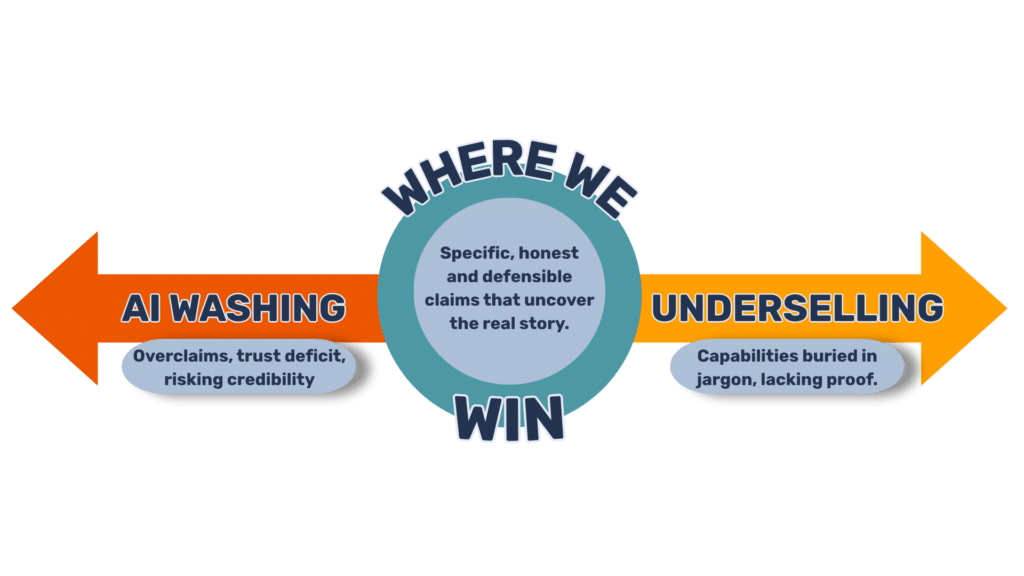
The AI market right now exists on a wide spectrum. On one side, you have AI washing or companies slapping “AI-powered” on products that run a couple of API calls and marketing it as transformational. On the other end, you have companies with genuinely impressive technology who are so afraid of overpromising that their messaging sounds like they’re describing a glorified spreadsheet.
Neither of these approaches works. AI washing backfires as soon as the market catches on. And it ALWAYS catches on. Underselling your true capabilities isn’t going to move the needle. The sweet spot is where PANBlast lives: Find the real, differentiated truth behind your AI product and communicate it with confidence, specificity and proof.
The Risk of AI Washing
AI washing happens when a company’s external messaging about its AI capabilities outpaces its actual capabilities. For example, claiming something is “AI-powered” when it’s basically just rules-based automation with a generative layer, or promoting capabilities that don’t stand up in a technical assessment.
This kind of overclaiming backfires quickly and often publicly. Reporters covering AI have gotten very good at asking specific technical questions that expose exaggerated claims. Remember when IBM got pummeled in the press over its marketing claims about Watson’s AI capabilities? Enterprise tech teams know their stuff and will put your claims to the test. If your product doesn’t live up to what you promised, they will talk.
In regulated industries, the stakes are higher than a bad press cycle. The EU AI Act has real documentation and disclosure requirements. Overclaiming can mean contract terminations, compliance audits, formal regulatory inquiries, and, in some cases, civil liability. And if you think operating outside of Europe insulates you, the FTC has made it clear that AI marketing claims are subject to the same standards as any other advertising.
Once trust is lost in this market, it’s very hard to get it back. The credibility you spent years building can unravel in the blink of an eye.
The PANBlast POV
Our job is to help you find the real story of your AI and get it in front of the right people in the most effective way. Finding and communicating the differentiated, defensible truth is the only thing that works in a market this skeptical.
How to Differentiate an AI Product When Everyone Sounds the Same
We’ve all heard the same basic messaging around AI:
“AI-powered”
“Intelligent automation”
“Transforming how teams work.”
At this point, these phrases are so overused that they no longer really communicate anything. In fact, readers have begun to tune them out.
Real differentiation in AI PR comes from specificity:
What specific problem do you solve that your top competitors can’t?
What outcome can you point to in an actual deployment vs. a demo?
What is your honest, unique and perhaps slightly contrarian take on where the category is going?
The same principle applies to LLM visibility. When every AI company is claiming faster, smarter, more scalable, the LLMs can’t differentiate you and neither can buyers. While generic positioning leads to generic citations, a contrarian take on where your category is heading or an honest perspective on what AI still can’t do will make an LLM recognize you as a source worth citing. These are also the things that make a reporter take interest, and that help companies stand out in media coverage.
A lot of founders conflate PR with marketing, and a lot of marketing teams conflate PR with press releases. There’s a big strategic difference.
PR’s job is to earn validation from sources your target buyer trusts independently.
That function is structurally different from any channel you can directly control. It’s also the reason PR compounds in ways that paid media placements and owned content can’t.
| Strategic PR | Marketing Hype | AI Washing | |
| Primary Goal | Earned credibility + category authority | Awareness + acquisition volume | Appear AI-relevant, fast |
| Credibility Built | High — third-party validated | Low — self-promotional | Negative — backfires when exposed |
| Timeline | 6–12 months, compounds over time | Near-term spikes | Short-term, high reputational risk |
| Best For | Trust, differentiation, long-term narrative | Volume plays, rapid testing | Nothing. Seriously. Don’t. |
Why AI-Generated and DIY PR Isn’t the Answer
“Can’t we just use AI to do our PR?”
It’s a fair question, especially from AI founders who are understandably bullish on the technology. The answer is: somewhat, but only very carefully, and definitely not in lieu of a real PR program.
GenAI is fine for a first draft or some initial research. But, here’s a quick list of what it CAN’T do:
- AI can’t build the journalist relationships that make the difference between a pitch that lands and one that gets deleted without being opened.
- AI can’t read the room on editorial timing. For example, knowing that a reporter is writing a big news story this week, this is not the moment to pitch.
- AI can’t flag the word or phrase in your messaging that’s going to be met with an eye roll from an editor who’s seen the same exact claim a hundred times.
- AI definitely can’t replicate the strategic judgment that comes from years of working with all kinds of technologies and companies at every stage. It’s about knowing what to say and what not to say.
Using AI-generated PR to market an AI company, in a market where the main challenge is building human trust, isn’t going to achieve the results you’re looking for.
Remember: Right now, the key to success is using authentic human voices:
- Founders with genuine perspectives
- Technical spokespeople with expertise and depth
- PR partners who can find and tell the story that actually resonates
An AI Slop Survival Guide: Why Being Human Is Your Best PR Strategy
Media Relations for AI Companies
TL;DR
AI beat reporters are smart, skeptical and looking for what’s proven and verifiable. A great pitch needs to be specific, honest, and interesting.
Key Takeaways
- Earned media targets buyers in their research journey and makes an impact no sales deck can replicate.
- Not all media coverage is equal. A placement in a vertical trade outlet that your buyer actually reads will have more impact than a top tech outlet they don’t.
- AI reporters want a unique POV, depth, customer outcomes with ROI and a compelling angle to write about.
Journalists covering AI are not the same as the journalists who covered the Internet bubble of 1999. They’re more skeptical of vendor claims, more averse to buzzwords and more likely to write a critical piece if they catch an overclaim. Getting earned coverage requires understanding:
- What they cover
- What they want
- What they’re tired of
- How to make yourself useful to their work
How Earned Media Builds Trust Across the Buyer Journey
One of the most common and persistent misconceptions about PR is that you can simply drop a press release, generate some impressions and reach your audience. This is especially misguided when it comes to PR for emerging AI companies.
Analyst research has become a multi-touch, multi-stakeholder process where most of the evaluation happens before the vendor ever gets contacted. Earned media coverage in credible outlets shows up throughout that process:
- A potential customer searching your company name finds a news story in a leading business technology outlet
- An IT director doing due diligence reads the trade publication that covered your customer case study
- A CFO approving a purchase sees your CEO or founder quoted in a business publication as a category expert
Each of these touchpoints does something a sales deck can’t: It provides third-party validation from a source the buyer trusts independently.
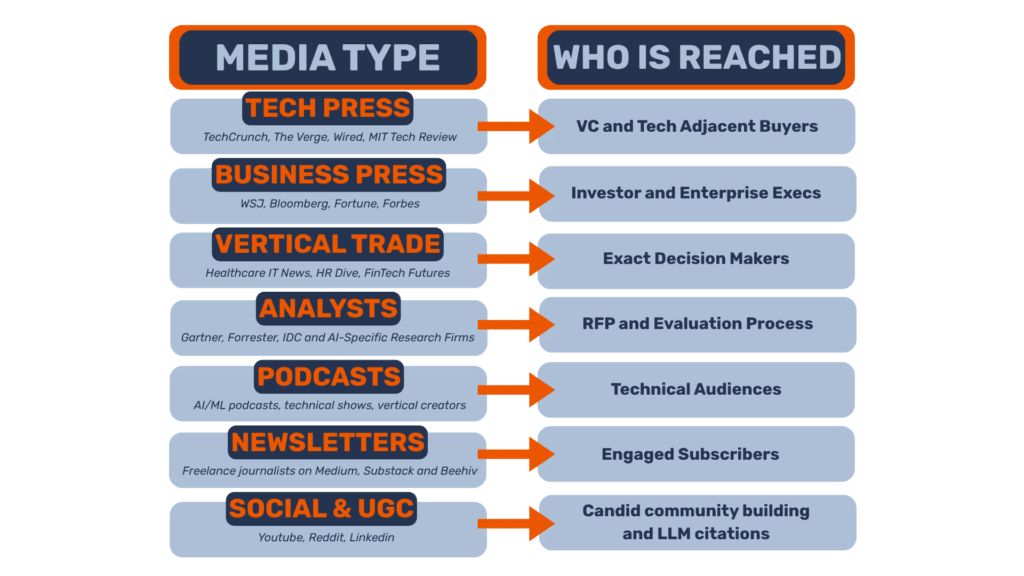
Which Media Actually Matter for AI Companies
Not all coverage is created equal, and a smart PR strategy doesn’t chase every outlet with every story. It’s about more than simply maximizing impression counts. The goal is to be in the media outlets that your target buyers, investors and partners are actually reading.
LLM Answer Optimization
When your buyers ask ChatGPT, Claude, Gemini or Perplexity about the best solutions in your category, what comes up? For most companies, the honest answer is: “We have no idea.” In this market, the AI tools ARE the research process.
Why LLM visibility is mandatory
PAN’s Brand Experience Report found that 38% skipped visiting a website entirely when an AI summary answered their question. The same research found 31% of ChatGPT citations from B2B prompts were hallucinated.
Translation: a third of your buyers may never reach your site, and when the model speaks for you, there’s a good chance it will get it wrong. Leaving your AI narrative to chance means letting the model fill in the blanks for you.
Find the prompts your buyers are actually using
To get your company or product into these search results, start by building a list of common questions your buyers are typing into an LLM, like “what’s the best AI platform for (use case)?” or “how do companies solve (problem you solve)?” That kind of thing.
LLM visibility tools let you run those specific prompts and see what comes back:
- Who is cited
- What sources the model is pulling from
- Where your competitors show up
That tells you exactly what type of content is actually feeding the answer, from earned media and LinkedIn posts to Reddit threads and analyst reports.
The signals are the ones PR already builds
The signals that drive LLM inclusion are the same ones PR has always supported:
- Earned coverage in authoritative outlets
- Consistent narrative
- Third-party validation
The difference now is that you can measure it in real time, see exactly where you’re winning and losing visibility against competitors, and adjust accordingly.
Build the PR foundation, then track whether it’s working where your buyers are actually looking.
| Media Type | Key outlets | Why it matters for AI companies |
| Mainstream tech press | TechCrunch, The Verge, Wired, MIT Technology Review | Broad credibility signal — often the first coverage VCs and tech-adjacent buyers see. |
| Business press | WSJ, Bloomberg, Forbes, Fortune | Critical for investor and enterprise buyer perception — especially pre-fundraise or exit. |
| Vertical trade media | Healthcare IT News, Retail Dive, HR Executive, FinTech Futures | Underrated and extremely powerful. Reaches exact decision-makers in your target vertical — a healthcare IT placement means more to a health system CIO than a TechCrunch mention. |
| Analyst coverage | Gartner, Forrester, IDC, AI-specific research firms | Shapes enterprise vendor evaluations and RFP processes — shows up when buyers are comparing options. |
| Podcasts and niche platforms | AI & ML podcasts, technical shows, vertical creator platforms | Builds depth and community trust traditional media can’t. Particularly valuable for technical audiences. Measure reach by relevance, not raw numbers. |
| Newsletter ecosystem across | Independent journalists, writers, reviewers and new media outlets across Medium, Substack and Beehiv | New media environment with independent journalists and creators telling stories on their terms to an engaged, subscribed audience. |
| Social media and UGC | Youtube, Reddit, Linkedin | Where real, candid conversations happen and one of the top citations for AI visibility. |
What Do AI Beat Reporters Want from Your Pitch?
Something real.
Consider the AI beat reporter’s POV:
- AI beat reporters have been pitched the same three angles hundreds of times.
- They can spot a marketing buzzword pitch in the first sentence.
- They know when a founder is delivering a rehearsed answer rather than a fresh perspective.
- Their job is to find what makes this company different from the hundreds of other AI companies in their inbox.
With that in mind, here’s what actually works in an AI pitch:
- A founder with a unique and slightly contrarian take on where the category is headed.
- A customer story with actual ROI numbers (not simply “significant efficiency gains, but 40% reduction in time spent on X.”)
- An honest acknowledgment of what AI doesn’t do well yet.
- A story that hasn’t been told before, connected to something their readers actually care about.
What doesn’t work?
- “We’re the only AI platform that…”
- Using a generic claim that three competitors could also make.
- A CEO who can pitch, but can’t answer deep follow-up questions.
- Embargoed announcements without a compelling narrative.
- Any pitch that opens with “In today’s fast-paced digital landscape…”
Establishing B2B SaaS Brand Trust Requires a Hype Squad
What AI reporters are actually looking for
A differentiated POV on where the category is headed and a willingness to defend it. Real outcomes from real deployments with clear metrics. A founder or CEO who can talk about what AI doesn’t do well yet. A story that’s genuinely new, not a repackaged press release.
Building Voice AI Market Leadership
| CLIENT SPOTLIGHT — PANBlast × PolyAI — Voice AI — Category Leadership | |||||
| CHALLENGE In early 2025, the conversational AI narrative shifted toward agentic AI and high-profile founders. Media attention clustered around hype, threatening PolyAI’s ability to defend its category lead and be found by buyers using AI-powered search. | APPROACH PANBlast ran a two-track media plan: tier-1 storytelling placing CEO Nikola Mrksić inside macro “AI agent economy” narratives, paired with a trade momentum motion across hospitality, retail, and CX outlets.Messaging was reframed around “voice agents customers want to talk to,” anchored in booking accuracy, resolution rates, and customer effort. Every asset was engineered for AI-era discoverability. | RESULTS 28 pieces of coverage matching previous year’s run-rate while lifting authority and link equity. WSJ feature with live PolyAI call demo drove 34 qualified pipeline sessions. | |||
| 42% SOV lead over nearest competitor | 706M Potential reach — 10× YoY | 61% Coverage with backlinks (vs. 55% target) | 50% Presence in priority “voice AI” queries | ||
| “By pairing marquee validation with vertical proof and building every asset for AI-era discoverability, PolyAI sustained category leadership, increased high-quality reach, and translated coverage into qualified engagement — turning earned media into lasting discoverability, traffic, and pipeline.”— Lydia Beechler, Director, PANBlast | |||||
PANBlast Helped PolyAI Be a Leader in the Voice AI Market
Thought Leadership for AI Founders
TL;DR
Real thought leadership around AI means having a unique perspective the market actually needs to hear and delivering it consistently enough to shape how the category is understood.
Key Takeaways
- Thought leadership is more than a blog post or a LinkedIn carousel. It’s a sustained body of unique, consistent perspective that earns attention and shifts how markets think over time.
- The best story mining questions are the uncomfortable ones, and the answers are almost always more interesting than the standard pitch.
- Don’t let it all ride on the CEO. Build a bench of technical and product voices who carry credibility with the audiences that matter most to your GTM.
Thought leadership is one of the most underused strategies in AI. While every founder calls themselves a thought leader, only a few have built the consistent, credible presence that actually influences how the market thinks. Here’s what a real thought leadership platform looks like and how to build it.
What Thought Leadership Really Means in AI
Thought leadership is having a perspective that the market actually wants to hear and saying it consistently enough to shape how a category is understood. It’s more than just a LinkedIn post or a speaking slot at a conference you sponsored.
The bar for credibility in AI is higher than almost any other category. Generic takes on AI’s potential are going to lose buyers and reporters immediately. And, if you’re running to ChatGPT for your spokesperson’s stance, they’ll be lost in the “sea of sameness” you’re trying to escape. Reporters can tell when a “thought leader” is recycling industry consensus rather than offering a new POV, and they already have 40 pitches in their inbox that sound exactly the same.
Make it clear that your spokesperson has done the work, has the scars to prove it, and they’re willing to say something honest and specific about what they’ve learned. Speaking with real authority is your most powerful PR asset.
What kind of thought leadership actually breaks through?
- Genuine POV on where the category is going
- Hot takes
- Perspective supported by personal experience
- Acknowledgment of what AI doesn’t do well yet
- A real human tone, rather than a bot
Story Mining to Find Your AI Company’s Real POV
Most AI founders have more interesting things to say than they realize. The problem is that they haven’t been asked the right questions and they are over-messaged. An experienced PR team knows how to get the good stuff from a spokesperson – a process we call story mining. Think of it as mining for gold, or the unique stories your company and people have to tell, then using them as raw materials to fuel your PR and thought leadership platforms.
The most valuable story mining questions are often the uncomfortable ones, especially around AI:
- What do most people believe about AI adoption that you disagree with?
- What are you hearing in conversations with customers?
- What are the real limitations of your product right now?
- If your company or product succeeds, what does that mean for the workforce or society at large?
- What’s the next big industry challenge?
- What’s an important issue or trend that nobody seems to be paying attention to?
- What customer outcome are you most proud of that no one outside your company knows about yet?
- What problems keep you up at night?
The answers to these types of questions are almost always more interesting than the average pitch because they surface real stories with specific details that signal the spokesperson really knows what they’re talking about. That’s the reason journalists, analysts and buyers respond to them too.
Building a Diverse Thought Leadership Bench
Your CEO is a great spokesperson, but they’re also in back-to-back meetings, on a plane or otherwise unavailable at the exact moment a reporter calls on deadline. If they’re your only spokesperson, your thought leadership program isn’t going to work.
Emerging AI companies are full of experts at every level, so use them! There’s no need to rely on one person. Sometimes an opportunity calls for specific expertise. A CTO who can write a grounded piece about the current limitations of LLMs in enterprise environments is going to be a better fit for a tech pub than a CEO profile might be. A VP of Product who can speak to real implementation challenges reaches a different audience than the founder’s origin story – and probably offers more credibility on that topic.
Build the bench intentionally by mapping your spokespeople to the audiences and outlets where their specific expertise will have the most impact. You don’t need to make everyone a thought leader, but you do need to make sure the right person is available when the call comes.
The Right Channels
A strong AI thought leadership program relies on multiple channels to reinforce each other:
- LLM visibility makes sure you’re coming up where your buyers are searching.
- A byline in a widely respected publication validates the perspective being shared on LinkedIn.
- A podcast appearance builds depth and provides a human element that a press release can’t.
- An op-ed in a trade publication gives the sales team something to share with prospects during evaluation.
If your goal is buyer trust and pipeline influence, niche channels often do better than mass-reach placements. Depending on your target buyer, a technical podcast reaching 1,000 ML engineers and enterprise architects can be more valuable than a mention in a top business technology magazine. A byline in a DevOps Substack or organic commentary in a Reddit thread may do more to move the needle than a CEO quote in a business press story.
PR at Every Stage of the AI Journey
TL;DR
PR grows up with your company. Start building your narrative and program early rather than waiting for a “PR moment.”
Key Takeaways
- Start earlier than you think, but only when you have a real story to tell. A bad first impression with a reporter is harder to undo than no impression at all.
- Funding announcements are a hook, not a strategy. What you attach to the announcement matters more than the number.
- By the time an acquisition conversation starts, or an S-1 is being drafted, the market narrative should already be set. PR builds market perception long before you need it.
Think of PR as a dial instead of a light switch, and that dial should move as your company does.
A pre-seed company and a Series B company are both “doing PR,” but they shouldn’t be doing the same PR. It would be a mistake to run a Series B program on a pre-seed narrative, or to wait until Series B to build the credibility you needed 18 months ago.
The approach has to match the stage, the proof points you actually have, your existing narrative and how much of the market’s attention you’ve earned to date. A company with two designers and a demo has a different story to tell than one with 50 enterprise deployments and a solid category position. Both stories are worth telling; they just need to be told differently.
When Should an AI Company Start PR?
Do you have a story to tell? Does your narrative have proof points and prepared spokespeople? It might be time to start PR.
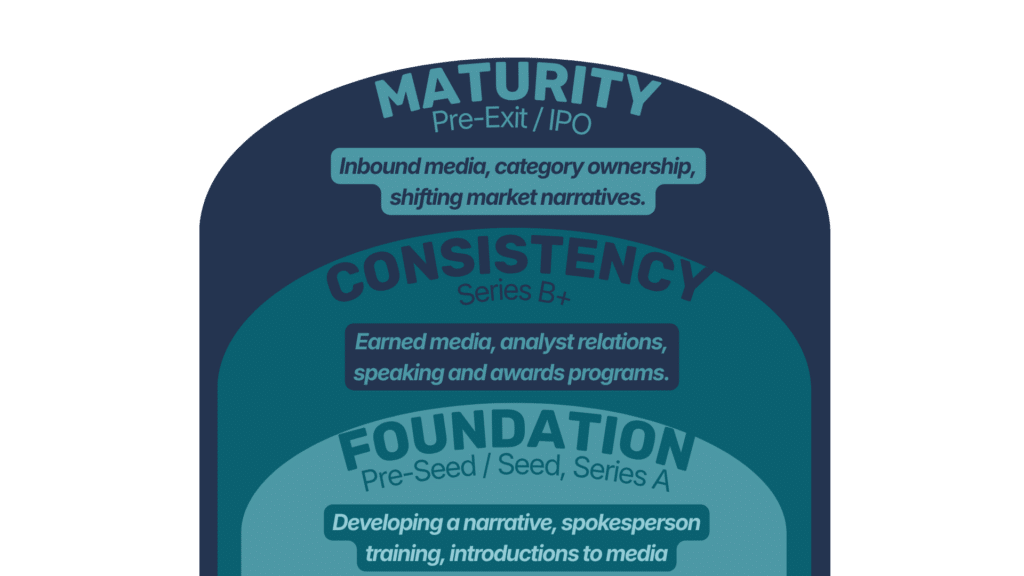
We built a model called the PR Maturity Curve to map PR activity across a company’s journey. Every AI company starts somewhere on the curve and most start at the beginning, which is exactly where they should be.
The model has three stages:
Stage 1: Foundation. You build the infrastructure and earn your first trust signals.
Stage 2: Consistency. You develop a program heartbeat and start showing up reliably in important outlets and conversations.
Stage 3: Maturity. The compounding benefit kicks in and PR starts to move from a cost center to a competitive advantage.
Most companies come to us somewhere in Stage 1 or early Stage 2. The bar to get started with PR efforts is likely lower than you think it is. An early-stage AI company isn’t expected to have a proven product with hundreds of customers, but it is expected to have the Foundation stage basics:
- Solve a specific, compelling problem.
- Build a credible founding team with relevant expertise.
- Have a unique POV on the category.
- Secure at least 1-2 early signals of validation (e.g., a design partner, an advisor with market credibility, and a visible founder with an existing audience).
Think of it as your PR starter pack. If you have these things in place, you’re ready to start building – training spokespeople, refining your narrative, making selective media introductions and establishing the kind of LinkedIn presence that makes a journalist think “I’ve seen this person’s name before” when your pitch lands in their inbox.
The Foundation work is what makes everything else possible. You can’t skip to Consistency (steady earned media, analyst relationships and a speaking program) without it. And you definitely can’t skip to Maturity (inbound media requests, customer participation and category recognition) without Consistency. The curve doesn’t bend for companies that try to shortcut it.
No need to wait until everything is perfect. In fact, it’s better to start building journalist relationships and refining your messaging early enough that by the time the big moments arrive, the market is already paying attention.
The biggest early-stage PR mistake
Waiting until the funding round to think about your narrative. By the time your Series A announcement is ready, you want reporters who already know who you are. Otherwise, you’re sending a cold pitch that’s competing with a dozen other funding announcements in their inbox that week.
PR at Every Stage: What to Prioritize
| Stage | PR Focus | Key Narratives | Anchor Tactics |
| Pre-Seed / Seed | Narrative development, founder voice | Why now, why us, what problem we solve | Story mining, selective media intros, founder LinkedIn content |
| Series A | Earned media at scale, category framing | Category creation or leadership, early customer proof | Tier-1 tech press, thought leadership bylines, speaking program launch, podcasts |
| Series B+ | Category ownership, analyst relations | Market leadership, enterprise credibility, ROI proof | Analyst briefings, awards program, vertical media, data-driven reporting |
| Pre-Exit / IPO | Investor perception, market narrative | Scale story, competitive differentiation, platform vision | Business press, investor-relevant coverage, M&A narrative prep, owned media |
The AI Funding Paradox
AI companies break from the SaaS playbook in a pretty significant way: in SaaS, funding typically follows traction. You show MRR, churn, expansion revenue, then you raise. In AI, the sequencing is often inverted. It’s not uncommon for an emerging AI company to close a double- or triple-digit round before a single customer has signed on the dotted line.
This creates a real PR problem: you have a massive number to announce and almost nothing to show for it yet in terms of market proof.
Resist the instinct to let the round do the talking. A significant raise with no customers is a credibility gauntlet. Reporters, especially the ones who cover AI seriously, will ask the hard questions:
- What does the market look like?
- Who’s actually using this?
- What problem does this solve that something else doesn’t?
If your answers are vague, you’ve used your biggest PR moment to raise more questions than you’ve answered.
Use the capital announcement to set up the story you’ll be telling for the next 12–18 months. That means:
- Anchoring the raise to a specific, defensible market thesis, not just TAM
- Naming the problem category you’re solving, even if the product isn’t fully baked
- Highlighting the team’s credibility as a stand-in for customer proof when proof isn’t available yet
- Being honest about where you are in the journey – reporters respect it, and buyers eventually do too.
The bar SaaS companies use to evaluate “is this company for real?” doesn’t apply here. AI companies are often building the category as they go. Your PR strategy has to account for that gap between capital raised and market validation and bridge it with narrative.
PR and the AI Exit
AI M&A activity is picking up steam, and if your company needs to be thinking about what that means for your narrative. There’s a very strong chance your company is a candidate. The narrative that follows you into that process should be built long before the first term sheet arrives.
The founders who understand this get serious long before the moment arrives. They use PR to:
- Establish category leadership
- Generate the analyst coverage that shows up in due diligence research
- Create the third-party validation that makes a valuation argument land
PR serves two functions here: It supports the exit and helps create the conditions for your company to reach the exit stage. By the time the S-1 is being drafted or the acquisition conversation is heading up, the market narrative should already be set.
Building a Holistic AI PR Program
TL;DR
The AI companies that win the narrative war aren’t over-indexing on a media relations program; they’re running a full PR ecosystem where every channel feeds the next one. That’s the difference between an earned media program and a PR strategy.
Key Takeaways
- A speaker placement program puts your executives on the right industry event stages in front of buyers, journalists and analysts.
- If your AI operates in a regulated space, your PR strategy needs to be built around proactive transparency, or someone else will define your narrative for you.
- PR and content (owned and earned) build on each other, making each element more effective over time. This only works if the program is consistent.
Media relations is an important part of a holistic PR program for an emerging AI company, but if that’s all you’re running, you’re leaving a lot on the table. The key is to consistently own your narrative by using multiple tactics in concert and letting them compound.
Speaking at Industry Events
Speaking at industry events and conferences puts your leadership team in front of buyers, journalists, analysts, and investors all at the same time. Done right, speaking engagements supercharge credibility and generate content you can repurpose for months.
Getting selected to speak is already a win. It’s third-party validation that your POV is worth paying attention to, and that signal lands with attendees before your speaker has said a single word. The real opportunity is what you do with the spotlight. A conference session is often mentioned and summarized in articles, recaps and social media.
The difference between a speaking engagement that lands and one that doesn’t is in the strategy. First, map your executives to the stages where their perspective reaches the audiences that matter. Next, prioritize sessions where they can say something impactful. Journalists who attend conferences are often looking for quotable sources. A speaker who goes slightly off-script and says something genuinely interesting is way more likely to end up in a story than one who recites the polished corporate script.
And while you’re there, watch what your competitors are saying on stage. That message you disagree with is your next speaker submission. The best thought leadership often starts with “here’s what everyone in this industry keeps getting wrong.”
How Speaking Opportunities Can Help Build Thought Leadership
Building Credibility and Validation Through Industry Awards
If you assume that industry awards are only for big players with big budgets, you’re missing out.
Ones to watch lists, emerging company recognitions, and category-specific innovation awards exist specifically for companies at the stage where third-party validation matters most (which, if you’re reading this, is probably right now).
There’s another benefit too. Awards generate the kind of listicle-style content that LLMs love, like: “Best AI solution for financial services” or “Top emerging platforms for enterprise automation.” This is the exact phrasing buyers are typing into ChatGPT and Perplexity when they’re doing their research. Getting your company named in that context can become a citation that puts you in front of the buyers you’re trying to reach.
There are three types of awards worth pursuing:
- Product and technology awards that validate your AI’s capabilities to technical buyers
- Company recognition (fastest-growing, best culture, etc.) that signals organizational health to investors and talent
- Individual executive awards that build personal brand credibility
Getting on Analysts’ Radar Before the RFP
Enterprise buyers do their research, and they tend to look to the trusted analyst firms like Gartner, Forrester, and IDC. The ecosystem of AI research is growing fast. Getting on the radar of these analysts is one of the highest-leverage investments a growth-stage AI company can make.
Beyond the Magic Quadrants and Forrester Waves, analysts write the research that shapes how buyers think about your category before they’ve even heard of you. They are interviewed for media coverage and advise investors. But you don’t want to be scrambling to be included when you’re already in active evaluation. There’s a process and a timeline to manage this effectively.
The Regulated AI Principle
You don’t get to dodge the hard questions about your AI product, but you do get to decide whether you get to answer them on your terms.
Social Channels: LinkedIn and Reddit Aren’t Optional
If you’re running a holistic PR program and your executives aren’t showing up consistently on LinkedIn, you’re missing out on one channels with the highest ROI.
LinkedIn is where your buyers research vendors, where journalists check whether a spokesperson is credible before returning a pitch, and where analysts form first impressions of your category narrative. A byline in a trade pub lands differently when the executive who wrote it has a LinkedIn presence to share, amplify and further engage. Focus on building a signal that compounds over time.
People trust people, not logos. This is even more important in AI where buyers are already bracing to be hit with hype. But this isn’t a vanity exercise. We’re talking about genuine thought leadership. One of the first things a reporter when they’re considering a pitch is open the spokesperson’s LinkedIn to decide whether they’re worth quoting.
What works on LinkedIn for AI companies:
- A real POV: get specific about how your exec sees the category evolving and what everyone else keeps getting wrong.
- Executive commentary on relevant news and trends. Not reposts with a 👍, but actual takes. Opinionated, specific, grounded in experience.
- Behind-the-scenes content: what you’re building, why you made a specific decision, what you got wrong. Authenticity is the scarcest resource in an AI market flooded with polish.
- Repurposed earned media: a byline, a podcast appearance, a quote in a major outlet. Share it with context, not just a link.
- Direct engagement: replies to industry conversations, not just broadcasting. LinkedIn’s algorithm rewards it, and it signals that there’s a real human behind the profile.
Reddit: Credibility You Can’t Buy
Reddit occupies a unique position in the AI landscape. Communities like r/MachineLearning, r/artificial, r/LocalLLaMA, and vertical-specific subs (r/devops, r/cybersecurity, r/healthIT, etc.) are full of the exact technical buyers, practitioners, and early adopters that AI companies most want to reach, and they have a finely tuned radar for anything that feels promotional.
That’s what makes Reddit hard and valuable in equal measure. You can’t parachute in to pitch. But if your executive (or technical team member) shows up as a genuine participant, answering questions, sharing real perspectives and engaging in threads, Reddit can become one of the most credible distribution channels you have.
The play isn’t to post about your company. It’s to build the kind of presence that means when someone does mention your company, or ask who the players in your category are, your name comes up from people who actually know you.
Used together, LinkedIn and Reddit create a social layer that reinforces every other part of your PR program. Earned media validates your LinkedIn presence. Your LinkedIn presence makes your pitches land better. Your Reddit credibility makes your company feel real to technical buyers before they’ve ever visited your site.

Owned content and earned media are part of the same system. For example:
- A thought leadership byline published in a credible media outlet
- This gives you validation to share on LinkedIn, send to prospects during the evaluation process and amplify to your email list
- Engagement with that content signals which topics resonate
- This informs your next media pitch
- That relationship leads to a profile on a Substack written by an industry vet
- The profile generates analyst attention
- The analyst relationship leads to inclusion in a research report
- The research reaches buyers doing their due diligence
Measuring What Matters
TL;DR
In PR for emerging AI companies, the key metrics are those connected to trust, pipeline influence, analyst positioning, and investor perception. Impressions are a vanity metric.
Key Takeaways
- Track quality and tier of coverage, not just volume. One WSJ quote or trade pub feature is worth more than a dozen mentions in lower-tier outlets.
- PR OKRs should connect directly to GTM objectives, like share of voice in a target vertical, analyst inclusion leading up to fundraising, and case study coverage before moving upmarket.
- Marketing teams are data-driven. PR reporting should look like the rest of your dashboard, with segmentation and outcome data that can be used to make strategic decisions.
The PR industry’s measurement problem has become even more challenging in the age of AI. The metrics that are easiest to track, like impressions and clip counts, are often the least connected to what actually matters. What actually matters is:
- Trust
- Pipeline influence
- Analyst positioning
- Investor perception
What PR Metrics Should Emerging AI Companies Focus on?
When we’re talking earned media only, the amount of coverage and potential reach only tell a piece of the story.
That’s why we built StoryScore, our proprietary quality metric that puts a single, defensible number on the value of an earned media placement. It’s a scale that lets you zoom in – “What made this piece impactful?” – or, zoom out – “Was this actually a good article for us?” without getting lost in vanity stats.
StoryScore tiers:
- Premier (8+) The pinnacle – features, quotes, and profiles in top-tier outlets that move the needle on category leadership.
- Spotlight (4-7): Solid, meaningful coverage – contributed content in a relevant trade publication, for example, that demonstrates a healthy PR program.
- Highlight (1-3): Smaller wins like mentions and press release pickups that contribute to overall momentum.
Beyond StoryScore, here are the metrics worth tracking:
- Share of voice in the AI category coverage. Do you show up as a leader or a mention in the stories that define your category?
- Tier and quality of placements. One WSJ piece is worth more than a dozen mentions in lower authority outlets.
- Coverage in the outlets your specific buyers, investors and partners read. There are generic tech press, but you want to be in the publications that show up in their research process.
- Analyst inclusion and positioning. Being in the right research report is worth more in enterprise sales cycles than almost any media hit.
- Backlink quality from earned media. A PR win on top of an SEO asset compounds over time while also generating direct referral traffic
- Pipeline influence. When PR coverage appears in buyer research journeys, sales conversations and win/loss analysis.
- Investor and acquirer perception. The qualitative signal of how potential buyers describe your market position.
- Overall AI and LLM visibility gains and losses against your competitive set, or the prompts you’re being cited against.
How Should Emerging AI Companies Set PR Objectives and Key Results (OKRs)
AI PR OKRs should be tied directly to business objectives vs. coverage counts:
- Increasing share of voice in a target vertical before a sales push
- Building analyst relationships before fundraising
- Establishing a technical thought leader before a product launch
Setting these OKRs requires a real conversation between PR and GTM leadership about what outcomes PR is being asked to deliver. That conversation ensures alignment on what PR is meant to accomplish.
Reporting that Belongs in Your Marketing Stack
AI marketing teams run on dashboards, attribution models and data that connect activities to outcomes. A monthly clip report with impression counts is not that.
PANBlast reports PR in a format AI marketing teams recognize. One that is:
- Connected to business outcomes, emphasizing quality over quantity
- Segmented by audience, outlet tier, and coverage type
- Focused on the metrics that inform decisions, like message pull-through and engagement
About PANBlast: Your AI PR Partner
PANBlast is the only PR agency in the U.S. dedicated to serving emerging AI and B2B SaaS brands, and we’ve been in the AI trenches long enough to know what reporters want and how to help find a company’s story.
PANBlast has been working with AI companies since before ‘AI company’ was a category on a VC term sheet. We know this market. We know the reporters who cover it seriously. And whether you have a fully baked AI story to tell or you’re looking for help developing your story, we can support you.
What makes working in AI categories different (and why are we good at it)?
- We’ve spent years getting comfortable with technical complexity narratives that evolve quickly, and the unique credibility challenges of emerging categories.
- We speak the language (LLMs, RAG, agentic AI, MLOps, and model governance)
- We have relationships with the journalists who go deep on AI rather than the ones who write the ‘AI is going to change everything’ trend pieces
- We know how to find the differentiated truth inside a company and turn it into PR that actually builds the market position founders are trying to reach.
Our AI PR Services
- Media relations. Earned coverage in the channels and outlets that move markets and influence buyer decisions.
- Social media and executive commentary. Use top channels like LinkedIn and Reddit to further amplify an expert’s visionary or technical knowledge.
- Thought leadership development. Story mining, byline writing, spokesperson coaching and content strategy.
- AI and LLM visibility auditing and reporting, with strategic recommendations across earned and owned assets.
- Analyst relations. Proactively getting on Gartner, Forrester, and AI-specific analyst radars.
- Speaking programs. Executive placement at the conferences and events that reach your specific buyers.
- Awards programs. Identifying and pursuing the third-party recognition that compounds credibility over time.
- Responsible AI communications – For companies in regulated or highly monitored categories.
What makes PANBlast the right fit to execute PR for emerging AI companies?
- Category depth. We understand your technology well enough to find the story that non-specialists miss.
- Reporter relationships. We have them with journalists who cover AI seriously, not just AI-adjacent.
- Track record. We’ve worked in complex, technically dense categories from early traction through exit.
- Data-driven reporting. We tie PR metrics to GTM outcomes, not vanity impression counts.
- Human-first philosophy. In a market where authenticity is the scarcest resource, we lead with it.
Ready to Build Your AI PR Program?
Whether you’re pre-launch, post-seed or scaling to Series B and beyond, PANBlast builds AI PR programs that grow with you. Let’s talk about what your company needs right now: panblastpr.com/contact-us/